

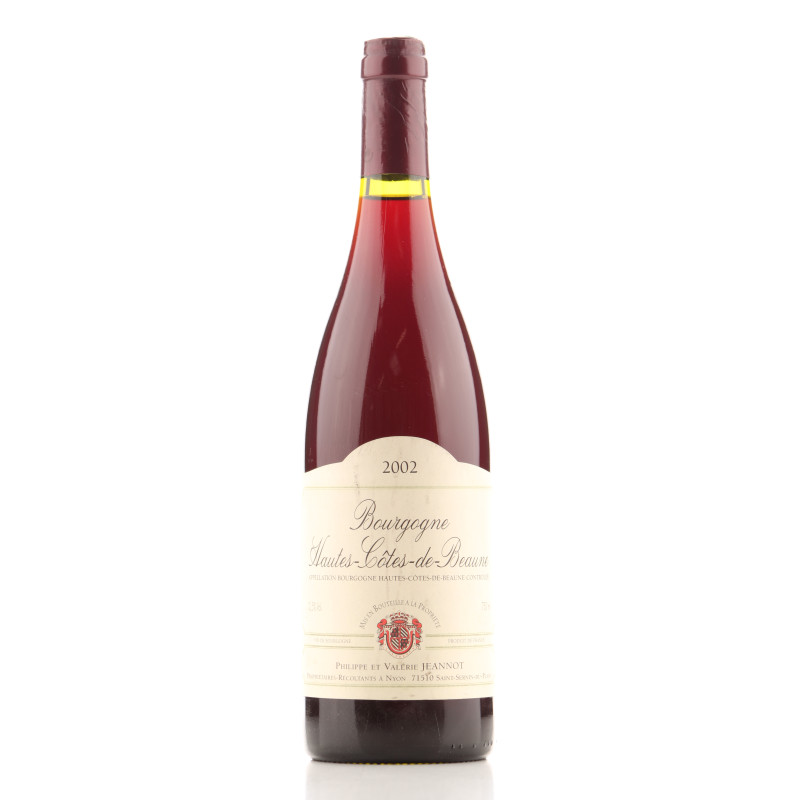
BOURGOGNE HAUTES COTES DE BEAUNE 2002 PHILIPPE JEANNOT
€20.00
Bouteille
75 cl
Tasting

To the eye
A deep garnet colour, which has almost certainly developed brick-red highlights after 24 years in the bottle.

Nose
Typically, a Hautes-Côtes de Beaune with this profile develops aromas of ripe red and black fruits; at this age, one can expect it to develop tertiary notes (forest floor, leather, sweet spices).

Palate
Initially full-bodied and generous on the palate, with abundant tannins; after prolonged ageing, this type of wine develops greater smoothness and tertiary complexity, sometimes at the expense of its initial fruitiness.

Pairing
White or red meat, game birds, or mature cheeses. Serve at 15–16°C, decanted to allow the wine to breathe before serving.

Aging potential
A wine to be enjoyed now, this bottle is a rare example of the exceptional 2002 vintage. We recommend checking the level and colour before purchasing: this is a curiosity for the discerning connoisseur rather than a classic wine for laying down.
Features
- Color Red
- Region Burgundy
- Designation Bourgogne
- Vintage 2002
- Format Bouteille
- Domain PHILIPPE JEANNOT
- Capacity 75 cl

Wines selected
by our experts

Order and pay
securely

100% of the wines
in stock

Free delivery
from 250€ in France

Your favorite wines
at your fingertips

Ban on the sale of alcoholic beverages to minors under 18 years of age
Proof of majority of the buyer is required at the time of online sale
Le barème établi par Robert Parker évalue les vins sur une échelle allant de 50 à 100 points afin d’aider les consommateurs à choisir leurs bouteilles. La grille de notation est la suivante :
96 à 100 Une cuvée grandiose : niveau exceptionnel.
90 à 95 Belle complexité aromatique, bel équilibre : niveau excellent.
80 à 89 Grande intensité aromatique, finesse et équilibre : bon niveau.
70 à 79 Plaisant, peu de complexité : niveau moyen.
60 à 69 Quelques défauts perceptibles : niveau très moyen.
50 à 59 Détection de défauts, manque d'équilibre : niveau acceptable.