Livraison avant Noël : commandez jusqu’au lundi 14/12 en standard ou mercredi 16/12 en express Free delivery from 250€ for France
Filter by
Region
Domain
Designation
Vintage
Format
Color
Price
€ €
Filter

Discover Charles Allexant et Fils

Charles Allexant et Fils estate, located in the heart of Burgundy, is a renowned family winery known for the finesse, elegance, and authenticity of its wines. For generations, the Allexant family has passionately cultivated its vineyards, showcasing the unique terroir of Burgundy’s appellations. The estate specializes in expressing the emblematic grape varieties: Pinot Noir for refined red wines and Chardonnay for delicate and complex white wines.

Terroir and Characteristics

The vineyard is planted on typical clay-limestone and limestone soils of the Burgundy region, with a temperate climate that favors optimal grape ripening. These conditions provide a perfect balance of minerality, freshness, and aromatic richness. Hand-harvesting ensures rigorous grape selection, allowing precise vinification respectful of Burgundy traditions.

Wine Profile

The estate’s red wines feature a beautiful structure, fine and silky tannins, and a complex aromatic palette combining red and black fruits, spices, and floral notes. The white wines reveal elegant freshness, good roundness, and subtle aromas of white-fleshed fruits, white flowers, and intense minerality. Each cuvée undergoes tailored aging, blending natural fermentation and patience, giving these wines remarkable typicity and aging potential.

Food Pairings

These wines pair perfectly with refined dishes such as almond trout filet, creamy poultry, coq au vin, and aged cheeses like Époisses or Comté. This range of pairings illustrates the versatility and elegance of Burgundy wines from Charles Allexant et Fils estate.

Our Charles Allexant et Fils Selection

Discover our exclusive selection of Charles Allexant et Fils wines on achetezduvin.fr. Enjoy fast and secure delivery to enrich your cellar with these precious crus, supported by the expertise of our sommeliers.

Afficher plus Afficher moins

Your questions, our answers.

Which colors and appellations make up the Charles Allexant et Fils selection?

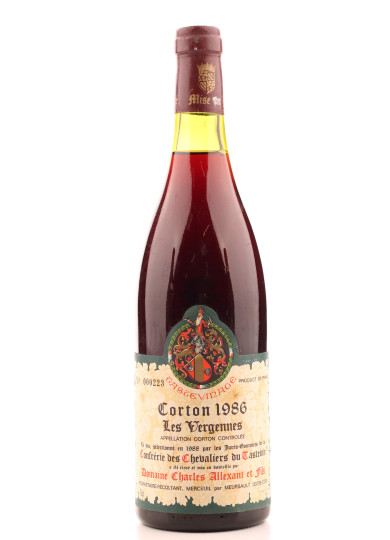
The category focuses on a single wine: Corton Les Vergennes Tastevine 1986 Charles Allexant et Fils. It is a red Burgundy wine in a 75 cl bottle; no white wines or other vintages are included in this selection.

What stylistic traits are associated with Charles Allexant et Fils reds?

The estate's presentation describes structured reds with fine, silky tannins and notes of red and black fruit, spices, and flowers. These characteristics refer to the estate's general style and are not tasting notes for Corton Les Vergennes 1986.

What dish might pair well with Corton Les Vergennes Tastevine 1986?

Coq au vin is one pairing suggested for the estate's wines. However, this is not a pairing specifically documented for this 1986 cuvée.

What information is provided about winemaking and aging at Charles Allexant et Fils?

The description mentions natural fermentation and aging tailored to each cuvée, in keeping with Burgundy traditions. It does not specify the aging duration or the vessels used for Corton Les Vergennes Tastevine 1986.

Is Charles Allexant et Fils presented as a family estate?

Yes, the presentation describes a family-run Burgundy estate where several generations have worked the vineyards. Finesse, elegance, and the expression of the terroirs are the main qualities highlighted, with no information provided about the founding date.
Notes Parker

Le barème établi par Robert Parker évalue les vins sur une échelle allant de 50 à 100 points afin d’aider les consommateurs à choisir leurs bouteilles. La grille de notation est la suivante :


96 à 100 Une cuvée grandiose : niveau exceptionnel.

90 à 95 Belle complexité aromatique, bel équilibre : niveau excellent.

80 à 89 Grande intensité aromatique, finesse et équilibre : bon niveau.

70 à 79 Plaisant, peu de complexité : niveau moyen.

60 à 69 Quelques défauts perceptibles : niveau très moyen.

50 à 59 Détection de défauts, manque d'équilibre : niveau acceptable.