Free delivery from 250€ for France
Filter by
Region
Domain
Designation
Vintage
Format
Color
Price
€ €
Filter

Your questions, our answers.

Which cuvée should I choose for a first introduction to the De Venoge house?

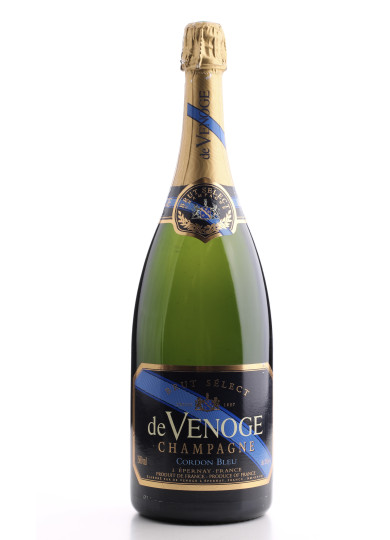
Brut Select Cordon Bleu is a fitting starting point: Cordon Bleu is an iconic cuvée from the house. In this selection, it is presented in a 150 cl magnum, with no vintage indicated.

Which De Venoge should I choose as a gift related to the year 1998?

Champagne Brut Millésimé De Venoge 1998 is the reference to choose to mark that year. It is presented in a 75 cl bottle; however, the vintage alone does not make it possible to determine its current stage of development.

Are these De Venoge white Champagnes necessarily blanc de blancs?

No: the white color alone is not enough to identify a Champagne made exclusively from white grapes. De Venoge’s description mentions Pinot Noir, Chardonnay and Pinot Meunier, without specifying the blend of either of the two cuvées.

What aromatic notes are mentioned in De Venoge’s description?

It evokes yellow fruits, golden brioche, white flowers and subtle toasted notes. These indications describe the house’s general style, but do not constitute separate tasting notes for Brut Millésimé 1998 or Brut Select Cordon Bleu.

What historical details place the De Venoge house in Champagne?

Founded in 1837, the De Venoge house is located on Avenue de Champagne in Épernay. Its description particularly highlights the Cordon Bleu cuvée, represented here by Brut Select in magnum.
Notes Parker

Le barème établi par Robert Parker évalue les vins sur une échelle allant de 50 à 100 points afin d’aider les consommateurs à choisir leurs bouteilles. La grille de notation est la suivante :


96 à 100 Une cuvée grandiose : niveau exceptionnel.

90 à 95 Belle complexité aromatique, bel équilibre : niveau excellent.

80 à 89 Grande intensité aromatique, finesse et équilibre : bon niveau.

70 à 79 Plaisant, peu de complexité : niveau moyen.

60 à 69 Quelques défauts perceptibles : niveau très moyen.

50 à 59 Détection de défauts, manque d'équilibre : niveau acceptable.