

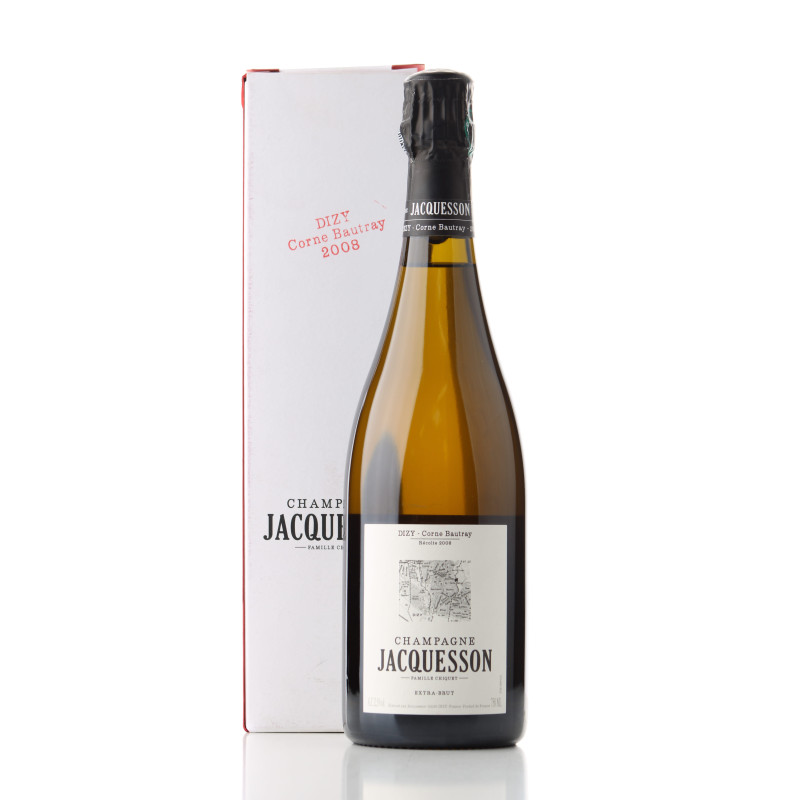
CHAMPAGNE EXTRA-BRUT 2008 JACQUESSON
Save €11.00
€180.00
€169.00
Bouteille
75 cl
Tasting

To the eye
The colour is a luminous golden yellow with subtle golden highlights. The effervescence is exceptionally refined, forming a delicate, persistent and perfectly even stream of bubbles.

Nose
The nose is exceptionally elegant, revealing aromas of pear, apple, lemon, citrus zest and white flowers, quickly joined by notes of brioche, hazelnut, fresh almond, chalk and subtle pastry notes that reflect its long ageing on lees.

Palate
The palate is straightforward, taut and remarkably precise. The lively attack gives way to a full-bodied, creamy texture, underpinned by magnificent minerality and exceptional freshness. Flavours of citrus, white fruit, toast and dried fruit linger on a very long, briny finish of great purity, characteristic of Jacquesson’s great Extra-Brut champagnes.

Pairing
This 2008 Jacquesson Extra-Brut Champagne will elegantly complement a scallop carpaccio, roast lobster, Gillardeau oysters, turbot with beurre blanc sauce or Bresse poultry in a creamy sauce. It will also bring out the best in a mature Comté or a well-aged Parmesan. To fully appreciate its finesse and aromatic complexity, we recommend serving it at between 10 and 12 °C in a large wine glass rather than a flute.

Aging potential
Produced from an exceptional vintage, this Jacquesson Extra-Brut 2008 Champagne is currently at a magnificent stage in its development but still has an ageing potential of 10 to 20 years, during which time it will develop increasingly complex aromas of dried fruit, honey and pastries.
Features
- Color White
- Region Champagne
- Designation CHAMPAGNE
- Vintage 2008
- Format Bouteille
- Domain JACQUESSON
- Capacity 75 cl

Wines selected
by our experts

Order and pay
securely

100% of the wines
in stock

Free delivery
from 250€ in France

Your favorite wines
at your fingertips

Ban on the sale of alcoholic beverages to minors under 18 years of age
Proof of majority of the buyer is required at the time of online sale
Le barème établi par Robert Parker évalue les vins sur une échelle allant de 50 à 100 points afin d’aider les consommateurs à choisir leurs bouteilles. La grille de notation est la suivante :
96 à 100 Une cuvée grandiose : niveau exceptionnel.
90 à 95 Belle complexité aromatique, bel équilibre : niveau excellent.
80 à 89 Grande intensité aromatique, finesse et équilibre : bon niveau.
70 à 79 Plaisant, peu de complexité : niveau moyen.
60 à 69 Quelques défauts perceptibles : niveau très moyen.
50 à 59 Détection de défauts, manque d'équilibre : niveau acceptable.