

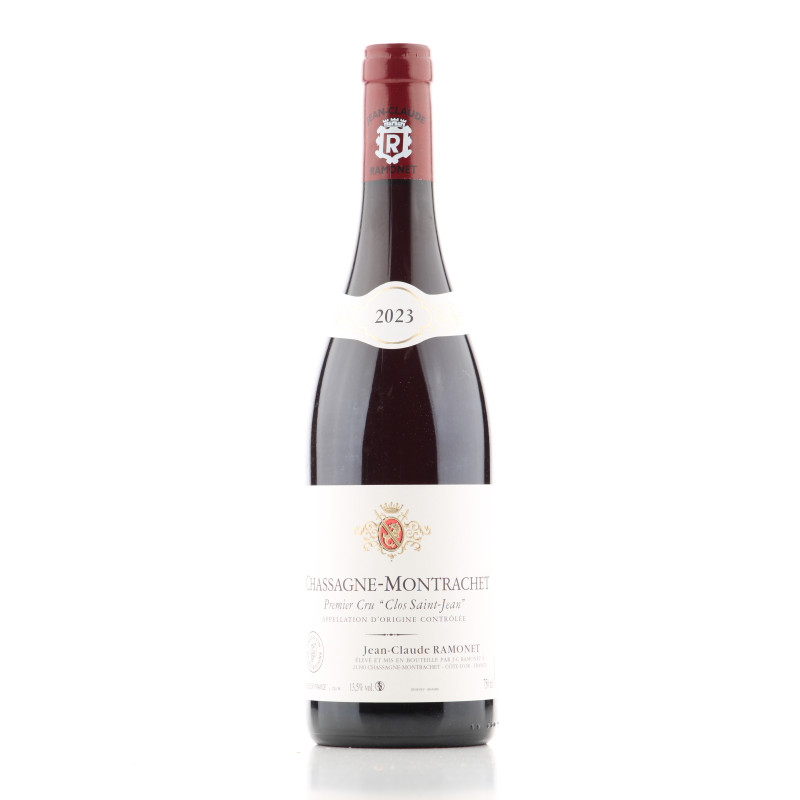
CHASSAGNE MONTRACHET 1ER CRU CLOS SAINT JEAN 2023 RAMONET
€80.00
Bouteille
75 cl
Tasting

To the eye
Une robe or clair étincelante et lumineuse, aux superbes reflets paille et vert tendre, témoignant d'une belle vivacité et d'une grande jeunesse de constitution.

Nose
D'une finesse envoûtante et d'une netteté éclatante. Le bouquet libère des arômes printaniers de fleurs blanches (aubépine, chèvrefeuille, acacia), rapidement enrichis par des notes de fruits à chair blanche croquants (poire, pêche de vigne), de zeste de citron, d'amande douce, de menthe poivrée et une minéralité crayeuse vibrante, soutenue par un boisé noble et millimétré.

Palate
L'attaque est vive, pure et ciselée. Le milieu de bouche séduit par son profil aérien et sa texture de dentelle, tranchant avec la rondeur habituelle de l'appellation pour imposer une verticalité et une tension minérale saisissantes. La finale est cristalline, portée par une amertume noble, des notes d'agrumes frais et une persistance saline et iodée d'une immense élégance.

Pairing
Sommet de raffinement, ce grand Chassagne-Montrachet tout en tension sublimera une cuisine délicate et iodée : un carpaccio de Saint-Jacques au citron caviar, un tartare de langoustines, un dos de cabillaud nacré au beurre blanc, ou une sole meunière. Côté fromages, mariez-le avec un chèvre frais cendré ou un jeune Saint-Nectaire.

Aging potential
Offrant déjà un plaisir sensoriel radieux grâce à son fruit éclatant, ce millésime 2023 dispose d'une trame acide et d'une pureté qui lui permettront d'évoluer magnifiquement en cave pendant 10 à 15 ans.
Features
- Color Red
- Region Burgundy
- Designation Chassagne Montrachet
- Vintage 2023
- Format Bouteille
- Domain RAMONET
- Capacity 75 cl
These products might interest you

Wines selected
by our experts

Order and pay
securely

100% of the wines
in stock

Free delivery
from 250€ in France

Your favorite wines
at your fingertips

Ban on the sale of alcoholic beverages to minors under 18 years of age
Proof of majority of the buyer is required at the time of online sale
Le barème établi par Robert Parker évalue les vins sur une échelle allant de 50 à 100 points afin d’aider les consommateurs à choisir leurs bouteilles. La grille de notation est la suivante :
96 à 100 Une cuvée grandiose : niveau exceptionnel.
90 à 95 Belle complexité aromatique, bel équilibre : niveau excellent.
80 à 89 Grande intensité aromatique, finesse et équilibre : bon niveau.
70 à 79 Plaisant, peu de complexité : niveau moyen.
60 à 69 Quelques défauts perceptibles : niveau très moyen.
50 à 59 Détection de défauts, manque d'équilibre : niveau acceptable.